

Not all physical therapy is created equal. Many people with scoliosis are put into generic back or core programs in busy clinics and then walk away thinking, “Physical therapy didn’t work for me.” For scoliosis and spinal deformities, treatment needs to be specific to your curve and delivered one-on-one by a therapist who truly understands scoliosis. That kind of specialized care can change your long-term path, not just your pain today.
A lunch conversation that reminded me why this matters
Not long ago, I had lunch with another physical therapy clinic owner.
He works primarily with insurance-based patients, and what impressed me was how hard he is still fighting to provide real, hands-on, thoughtful care – even with tight reimbursement and time pressures.
That is not always the case.
Many clinics are forced into (or choose) a high-volume model, where a therapist may be double or even triple booked.
You might get 10 minutes with the physical therapist and then spend the rest of the session doing exercises with someone who has very limited training.
Then, when results are not great, people understandably judge “physical therapy” as a whole.
I hear it all the time in our clinic: “I already tried PT. It didn’t help.”
When I ask what it looked like, it is usually a few generic back exercises in a crowded gym, with very little one-on-one time or curve-specific guidance.
That experience is very different from what I would call true physical therapy.
True physical therapy is time with a licensed physical therapist who is fully engaged in understanding your body, your condition, and your goals.
And for scoliosis, that therapist also needs specialized training.
Not all physical therapy is the same
The high-volume, insurance-driven model
In many traditional clinics, the schedule drives the care.
To stay afloat under low insurance reimbursement, some clinics:
- Double or triple book appointments
- Use unlicensed aides or techs to run much of the session
- Rely on the same few exercise sheets for almost everyone
If you have a simple ankle sprain, you might still do reasonably well in that model.
But scoliosis and spinal deformity are not simple.
They are three-dimensional conditions affecting the way your spine curves, rotates, and loads with every breath and every step.
A one-size-fits-all back program rarely matches that complexity.
What true one-on-one PT looks like
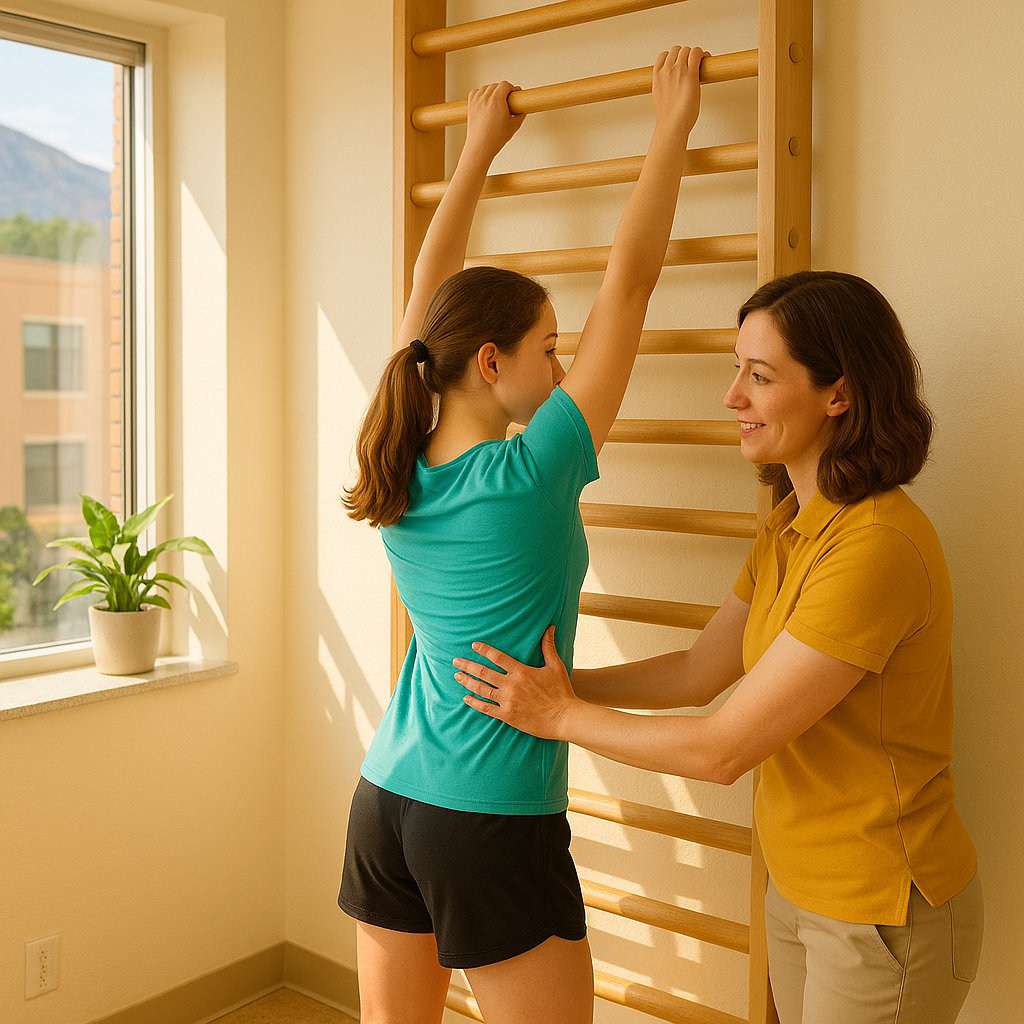
In contrast, one-on-one physical therapy looks and feels different.
You have the full attention of a physical therapist for the entire session.
Your treatment is based on a real evaluation, not just a diagnosis code.
You have time to ask questions, to understand what is happening in your spine, and to practice movements correctly.
In our scoliosis program at Align Therapy, every session is:
- One-on-one
- Delivered by a licensed physical therapist
- Guided by scoliosis-specific training and experience
That is not a luxury detail.
It is the foundation for truly curve-specific care.
Why scoliosis needs something more specific
Scoliosis is 3D, not just “bad posture”
Scoliosis is more than a side bend in the spine.
The vertebrae also twist, and the rib cage follows.
That combination creates a three-dimensional shape that is different in every single person.
For example, one person might have a right thoracic curve with a rib hump on the right and a left lumbar curve below.
Another might have a single long curve with very different muscle imbalances.
On top of that, scoliosis can affect:
- Balance and body awareness
- Breathing mechanics
- Muscle endurance on one side vs the other
- How confident you feel standing and moving
So when someone with scoliosis is given a generic core program – a few planks, crunches, and back extensions – it often misses the mark.
Sometimes it can even reinforce the stronger side and ignore the weaker, more collapsed side.
General PT vs scoliosis-specific PT
General physical therapy education does cover spinal conditions.
But scoliosis is usually one chapter in a much bigger textbook.
Most therapists are not deeply trained in curve-specific exercise.
That does not mean they are bad therapists.
It just means their tools are more general.
Scoliosis-specific physical therapy is different.
It focuses on:
- Understanding your exact curve pattern (or patterns)
- Teaching you how to actively correct that pattern in 3D
- Building strength and endurance in those corrected positions
- Integrating those corrections into daily life activities
Research on scoliosis-specific exercises shows that targeted, active self-correction can improve posture, function, and quality of life in people with scoliosis when compared with usual care.
It is not about a magic exercise.
It is about a precise recipe tailored to your spine.
If scoliosis is like a custom-shaped tree, generic PT is like watering the whole forest.
Scoliosis-specific PT is like carefully staking, guiding, and supporting that one tree so it grows as well as it can.
How specialized scoliosis PT works at Align Therapy

One-on-one care with a scoliosis-trained therapist
In our scoliosis program, every visit is one-on-one with a physical therapist who has specialized training in scoliosis-specific exercise.
We take the time to:
- Review your history, imaging, and previous treatments
- Evaluate your posture, movement, breathing, and muscle balance
- Explain your curve pattern in language that makes sense
For many people, that explanation alone is a relief.
You can finally see how your body is working, instead of feeling like it is just “crooked” or “wrong.”
We then build a plan that is unique to you.
Curve-specific exercise planning
Scoliosis-specific exercise is not about doing everything equally on both sides.
It is about doing the right things on the right side, in the right direction, with the right support.
We might focus on:
- Lengthening and opening the concave, more collapsed side of your curve
- Strengthening and stabilizing the convex side where the ribs and muscles are more prominent
- Using specific breathing patterns to expand the tight areas of your rib cage
- Training your brain to feel a more centered, balanced position
Two people with scoliosis in the same room might be doing completely different exercises.
That is exactly how it should be.
Over time, the goal is to help you:
- Improve your posture and alignment in a way that is realistic for your spine
- Build a strong, supportive muscle system around your curve
- Learn home strategies so you are not dependent on the clinic forever
Movement is medicine – but only if it is the right movement for your body.
Support beyond pain relief
Pain is often what brings people in.
But scoliosis care should not stop there.
We also focus on:
- Reducing fatigue and improving endurance for standing, walking, and daily tasks
- Making sitting, driving, and working at a desk more comfortable
- Helping you feel more confident about how you look and move
For teens and young adults, that can mean feeling more at ease in social situations.
For adults 35 and older, it often means keeping up with kids, grandkids, work, and hobbies without feeling held back by your spine.
If you are interested in some of the science behind this approach, you can explore our scoliosis research page.
A medical analogy: heart problems and scoliosis
If you had a significant heart problem, you would not stay only with a general practice doctor.
You would see a cardiologist.
Your primary care doctor is still important and very valuable, but a cardiologist has deeper training and tools for complex heart issues.
Scoliosis is similar.
General physical therapists are like excellent primary care clinicians for movement.
They help with many problems: ankle sprains, general back pain, balance, post-op rehab, and more.
But when you have a spinal deformity like scoliosis, especially if it is progressive, painful, or affecting your daily life, a scoliosis specialist is often the better fit.
It is not about one being “better” than the other.
It is about matching the right level of specialization to the complexity of your condition.
How to know if your scoliosis care is truly specialized
Here are some signs that you are receiving scoliosis-specific, high-quality care:
- You spend most or all of your visit with a licensed physical therapist, not being passed from one person to another.
- Your therapist can clearly describe your curve pattern (for example, right thoracic, left lumbar) and show you how it looks in your body.
- Your exercises feel tailored to your spine, not just standard back or ab exercises you have seen online.
- You are taught how to actively correct your posture in 3D, not just “sit up straighter.”
- Breathing and rib cage movement are part of your program, not an afterthought.
- Your goals go beyond pain to include function, confidence, and long-term spine health.
- You are given a home plan that evolves over time, not a static handout used for everyone.
If most of your sessions so far have involved doing the same exercises as the person next to you, with very little explanation about your curve, it may be time to ask some questions.
What to do if “PT didn’t work” for your scoliosis
If you have already tried physical therapy and did not get the results you hoped for, please do not assume your body is the problem.
More often, the problem is a mismatch between the care provided and what your spine truly needs.
It is completely reasonable to seek a second opinion with a scoliosis-focused therapist.
When I talk with patients about this, I often say:
“You did not fail therapy. Therapy just was not designed for your curve.”
A fresh, specialized look can:
- Reassess your current curve and symptoms
- Clarify realistic goals
- Build a plan that makes sense for your life right now
Small, consistent steps create real change, especially when they are the right steps.
Taking your next step

You deserve more than a generic routine in a crowded gym.
If you or someone you care about is living with scoliosis, specialized, one-on-one physical therapy can make a real difference in how your spine functions, how you move, and how you feel about your body.
You do not have to navigate this alone.
If you are in the Lehi, Utah area and want to see what curve-specific, one-on-one scoliosis care feels like, we would be glad to talk with you and see whether our approach is a good fit.
Book your free Discovery Visit to learn more about what specialized treatment for scoliosis is like.
This information is for educational purposes only and is not a substitute for professional medical advice, diagnosis, or treatment.


